



Why are increasing numbers of nurses asking whether the profession needs to evolve?
For more than a century, learning disability nursing has adapted to changing social attitudes, healthcare systems and service models. The profession has survived institutionalisation, deinstitutionalisation, the move from hospital to community-based support, and significant changes in how society understands disability.
Today, however, learning disability nursing faces another challenge.
The workforce is shrinking. Student numbers have fallen. Universities have closed programmes. In some parts of England, there are now very limited routes into the profession. At the same time, many learning disability nurses continue to report hearing comments such as “it’s a dying profession” or “it’s not proper nursing”.
These challenges have prompted a growing discussion about the future of learning disability nursing and whether the current registration model remains fit for purpose in modern health and care systems.
This is not a new debate.
Questions about where learning disability nursing sits within healthcare have existed for decades. What is perhaps new is the urgency of the conversation.
The Question Being Asked
One of the questions emerging from recent professional discussions is whether the current field of registration for Registered Nurses in Learning Disabilities (RNLDs) remains the most effective way to attract students, expand career opportunities and secure the future of specialist learning disability nursing.
Some have suggested that a broader framework, such as a neurodisability nursing registration, could help improve visibility and create wider career pathways while maintaining specialist learning disability nursing roles.
Others have raised significant concerns that such a change could dilute learning disability nursing, weaken specialist services or further marginalise the voices of people with learning disabilities.
These concerns are legitimate and deserve careful consideration.
Importantly, this debate is not about whether learning disability nursing is valuable.
The evidence is clear that it is.
The question is whether the structure and language surrounding registration continue to support the profession’s long-term sustainability.
Listening to the Profession
To better understand current views, PBS4 undertook a professional engagement exercise between February and April 2026.
The questionnaire was shared through professional networks and social media and generated 438 responses from learning disability nurses, student nurses and other stakeholders. It was designed as an engagement exercise rather than formal research and should be viewed as a snapshot of opinion rather than representative evidence.
The findings revealed a profession that is deeply engaged with the discussion but far from united on the solution.
When asked whether the field should remain unchanged, learning disability nurses were almost evenly divided.
When presented with the specific suggestion of changing the registration field to “Registered Nurse in Neurodisability”, opinions remained split, with concerns frequently focused on the potential impact on learning disability services and professional identity.
One particularly interesting finding was that student learning disability nurses appeared more open to change than the existing workforce. Their comments often linked potential change to improved career opportunities, greater visibility and a more sustainable future for the profession.
Perhaps the strongest message from the responses was not support or opposition, but uncertainty.
Many respondents recognised challenges with the current situation while remaining unconvinced that any proposed alternative had yet been fully defined.
Q1: Should the field remain unchanged?
Registered Nurses in Learning Disabilities
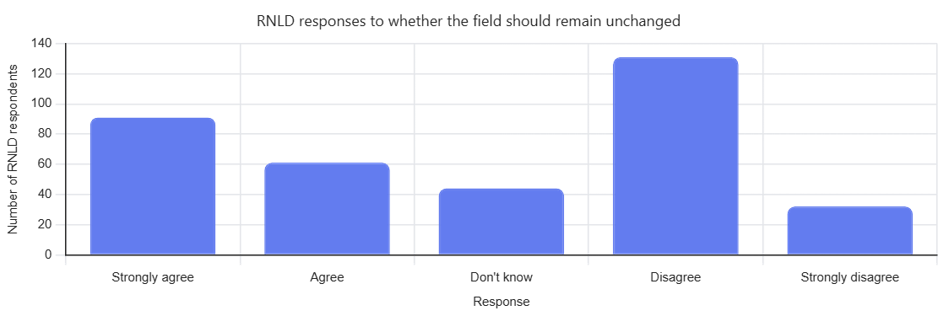
Among RNLD respondents, views were closely divided: 42.3% agreed that the field should remain unchanged, while 45.4% disagreed; 12.3% were unsure.
Student Learning Disability Nurses
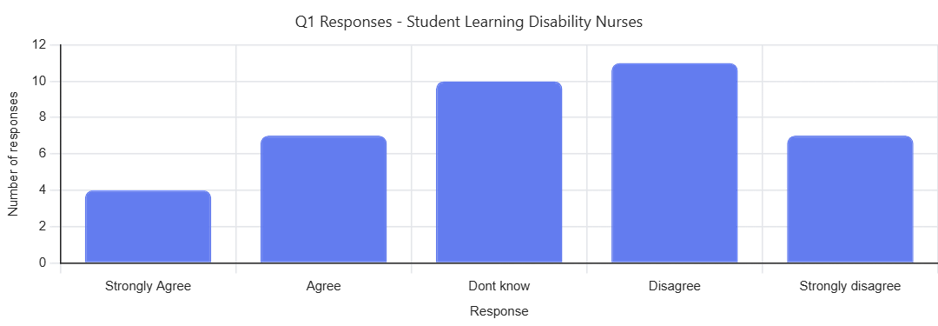
Students showed a clearer leaning towards change: 28.2% wanted the field to remain unchanged, 46.2% disagreed with keeping it unchanged, and 25.6% were unsure.
Other respondents
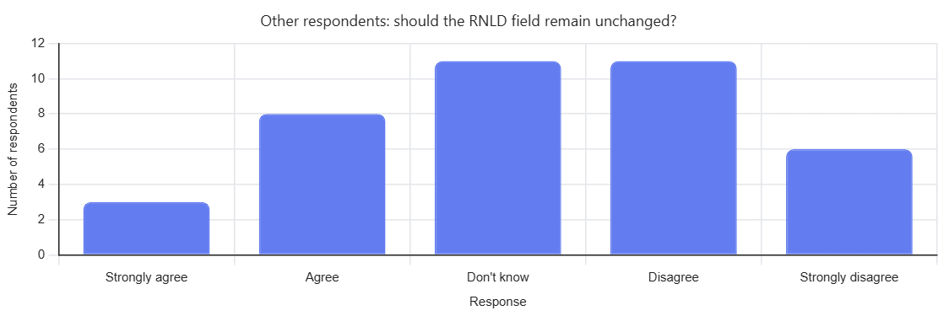
Other stakeholder responses showed less support for the status quo and greater uncertainty than the RNLD group. These results should be interpreted cautiously because the group was small.
Q2: Should the field change to Registered Nurse in Neurodisability?
Registered Nurses in Learning Disabilities
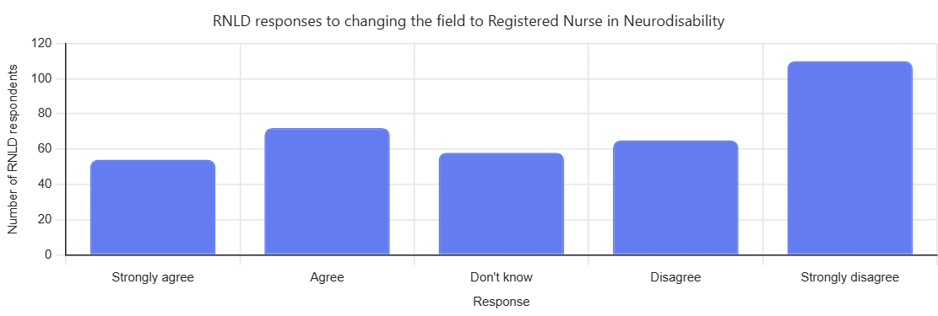
Support for this specific proposal was lower among RNLDs: 35.4% agreed or strongly agreed, 49.1% disagreed or strongly disagreed, and 16.3% were unsure.
Student Learning Disability Nurses
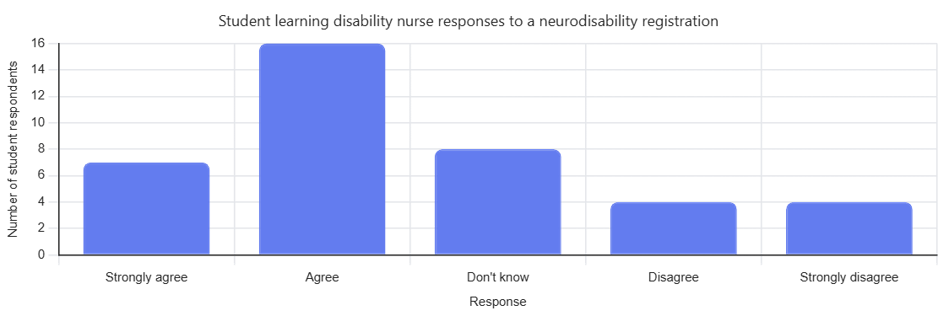
Students were more supportive of the neurodisability proposal: 59.0% agreed or strongly agreed, 20.5% disagreed or strongly disagreed, and 20.5% were unsure.
Other respondents
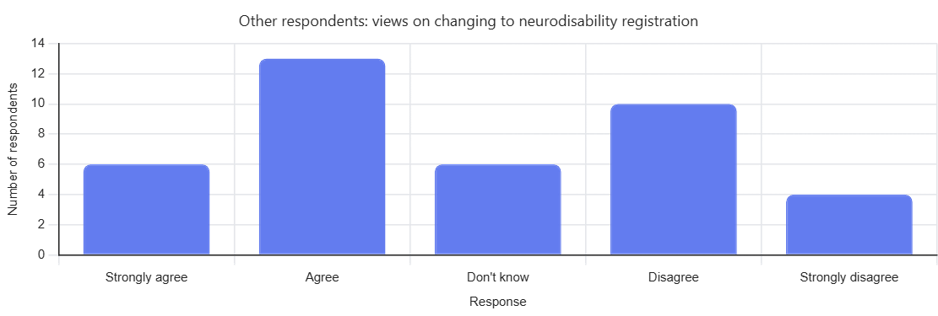
Among other respondents, 48.7% supported the proposal, 35.9% opposed it and 15.4% were unsure, indicating a more balanced spread of views.
Q3: Should the field change, but to something different from Neurodisability?
Registered Nurses in Learning Disabilities
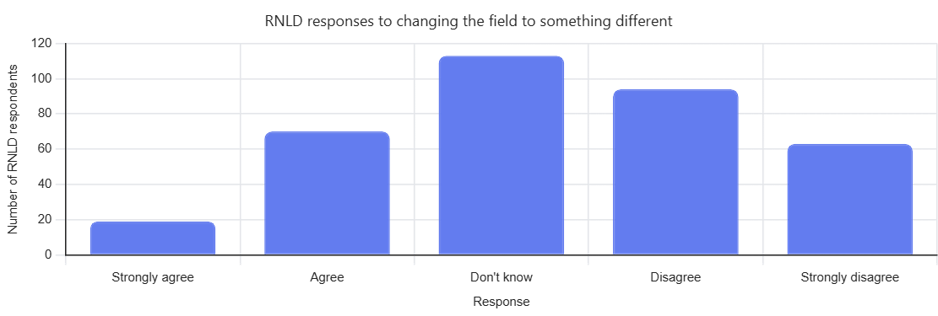
Uncertainty was the largest single response among RNLDs (31.5%). A further 24.8% supported a different change, while 43.7% disagreed or strongly disagreed.
Student Learning Disability Nurses
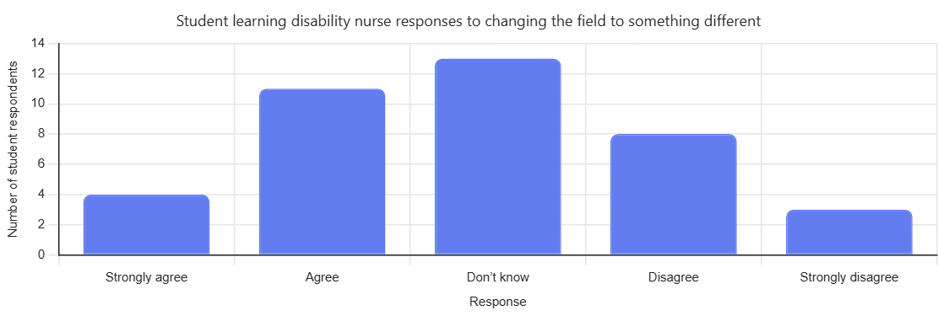
Student responses were also mixed: 38.5% supported a different change, 28.2% disagreed or strongly disagreed, and 33.3% were unsure.
Other respondents
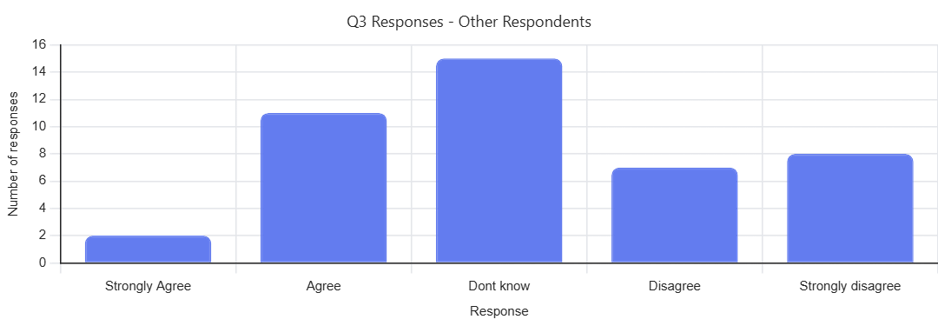
Other respondents were similarly uncertain: 34.8% were unsure, 30.2% supported a different change and 34.8% disagreed or strongly disagreed.
What Are People Worried About?
The most frequently cited concern was dilution.
Learning disability nurses have spent decades fighting for specialist recognition. Many fear that broadening registration could result in people with learning disabilities becoming less visible within services and policy structures.
These concerns are understandable.
Recent years have seen increasing use of combined “learning disability and autism” services and job roles. Some people argue that this has already led to confusion about distinct needs and specialist expertise.
Many respondents worried that a broader registration framework could accelerate this trend unless appropriate safeguards were put in place.
There were also concerns that changes to registration could affect jobs, commissioning arrangements or specialist service provision.
Any future discussion about reform would need to address these issues directly.
What Are People Hoping Could Improve?
At the same time, many contributors felt that doing nothing also carries risks.
If student recruitment continues to decline and educational opportunities continue to reduce, the long-term sustainability of learning disability nursing may be threatened.
Supporters of reform often argued that a broader registration framework could:
- Increase public understanding of the profession.
- Create wider employment opportunities.
- Improve career progression.
- Attract more students into nursing.
- Better reflect modern health and care services.
Notably, many supporters did not see these aims as replacing learning disability nursing.
Rather, they saw them as a potential way of protecting it.
Neurodisability Is Not the Same as Neurodiversity
One challenge that repeatedly emerges within these discussions is confusion between the terms neurodisability and neurodiversity.
They are not the same thing.
In healthcare literature, neurodisability is generally used to describe long-term conditions associated with impairments affecting the brain or neuromuscular system that can impact areas such as communication, cognition, movement, behaviour and self-care. This includes conditions such as intellectual disability, cerebral palsy, epilepsy and acquired brain injury.
Neurodiversity, by contrast, is typically associated with understanding and valuing neurological differences as part of human diversity.
The distinction matters because many objections to the term “neurodisability nursing” appear to stem from concerns about autism-focused services or assumptions that learning disability nursing would be subsumed into broader neurodivergence agendas.
Whether those concerns would materialise in practice is part of the ongoing debate.
Perhaps We Are Asking the Wrong Question
As the discussion has developed, I have become less convinced that the central question is whether learning disability nursing should become neurodisability nursing.
The more important question may be:
Why are increasing numbers of nurses asking this question in the first place?
The workforce challenges are real.
The visibility challenges are real.
The reduction in training opportunities is real.
The concern about the future of the profession is real.
As a result, the conversation is not simply about changing a title. It is about how we ensure learning disability nursing remains visible, attractive, sustainable and influential for future generations.
Evolution Rather Than Erosion
Learning disability nursing has survived and adapted for more than 100 years.
Its future should not be determined by fear of change, nor by change for its own sake.
The responses to this engagement exercise suggest that there is broad agreement on one point: specialist learning disability nursing expertise must be protected.
Where opinions differ is whether a change in registration could strengthen that protection or weaken it.
That debate is unlikely to disappear.
If anything, it is likely to grow.
Whatever view people take, the profession benefits from being willing to have the conversation openly, respectfully and with a shared commitment to improving outcomes for people with learning disabilities.
Because ultimately, the future of learning disability nursing is too important not to discuss.
Written By Nicole Hepplewhite

Nicole is a Registered Learning Disability Nurse and the Head of Clinical and Training at PBS4. She has been part of the PBS4 team for 5 years, working within our clinical team to ensure that the people we support are empowered and enabled to live the lives they choose.